Ion Exchange Membranes (IEM)
What ion exchange membranes are, how protons and hydroxide ions move through them, and the physical and electrochemical properties that decide which membrane fits your electrolyzer or fuel cell.
- Authors
- METNMAT Research Team
- Published
- Updated
- Updated 25 Aug 2026
- Reading time
- 2 min read
Abstract
Ion exchange membranes (IEMs) are semipermeable dense layers that selectively transport ions, and they sit at the heart of green hydrogen production and fuel cells. This article introduces the two membrane families — cation and anion exchange membranes — explains the vehicular and Grotthuss proton-transport mechanisms, and summarises the physical and electrochemical properties (thickness, swelling ratio, porosity, areal resistance, ionic selectivity) that determine membrane performance in real devices.
- Keywords
- ion exchange membrane, IEM, PEM, AEM, proton exchange membrane, Grotthuss mechanism, green hydrogen, fuel cells
- Research area
- Membrane electrochemistry
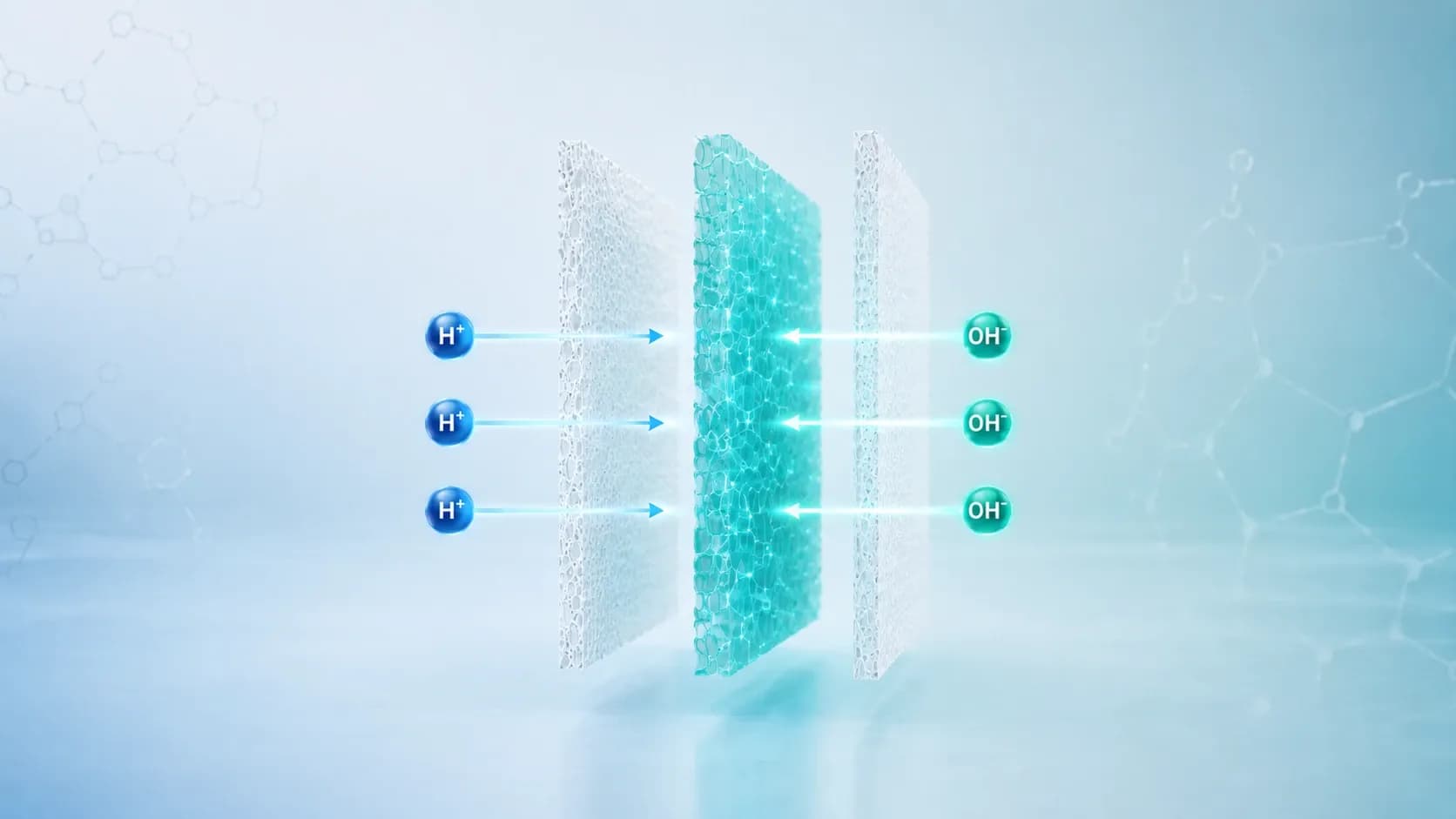
An ion exchange membrane (IEM) is a semipermeable dense layer that selectively allows ions to pass through. IEMs are broadly divided into two families: anion exchange membranes (AEM) and cation exchange membranes (CEM) — as the names suggest, AEMs and CEMs selectively allow anions and cations to pass through them, respectively. IEMs are widely used in different applications, including the energy, water treatment, pharmaceutical and food industries. With the increasing demand and aspiration of building a greener future, IEMs are abundantly used in green hydrogen production and its utilisation in fuel cells.
However, in hydrogen energy applications the cation to be transported is the proton (H+), hence CEMs are often referred to as proton exchange membranes (PEMs) in water electrolyzers and fuel cells. The mechanisms usually involved in the transport of protons are the vehicular mechanism and the Grotthuss mechanism, also known as the hopping/shuttling mechanism. The vehicular mechanism involves transport of protons in the form of H3O+ ions from one side to the other via diffusion or movement, without transfer of the proton to another water molecule. The Grotthuss mechanism, in contrast, involves continuous transfer of the proton to the next water molecule, creating a continuous chain. This can be achieved if the polymer of the membrane itself supports the mechanism — hence polymers involving anionic functional groups (e.g. –OH) in their structures are used, for example perfluorosulfonic acid (PFSA) and sulphonated poly ether ether ketone (SPEEK).
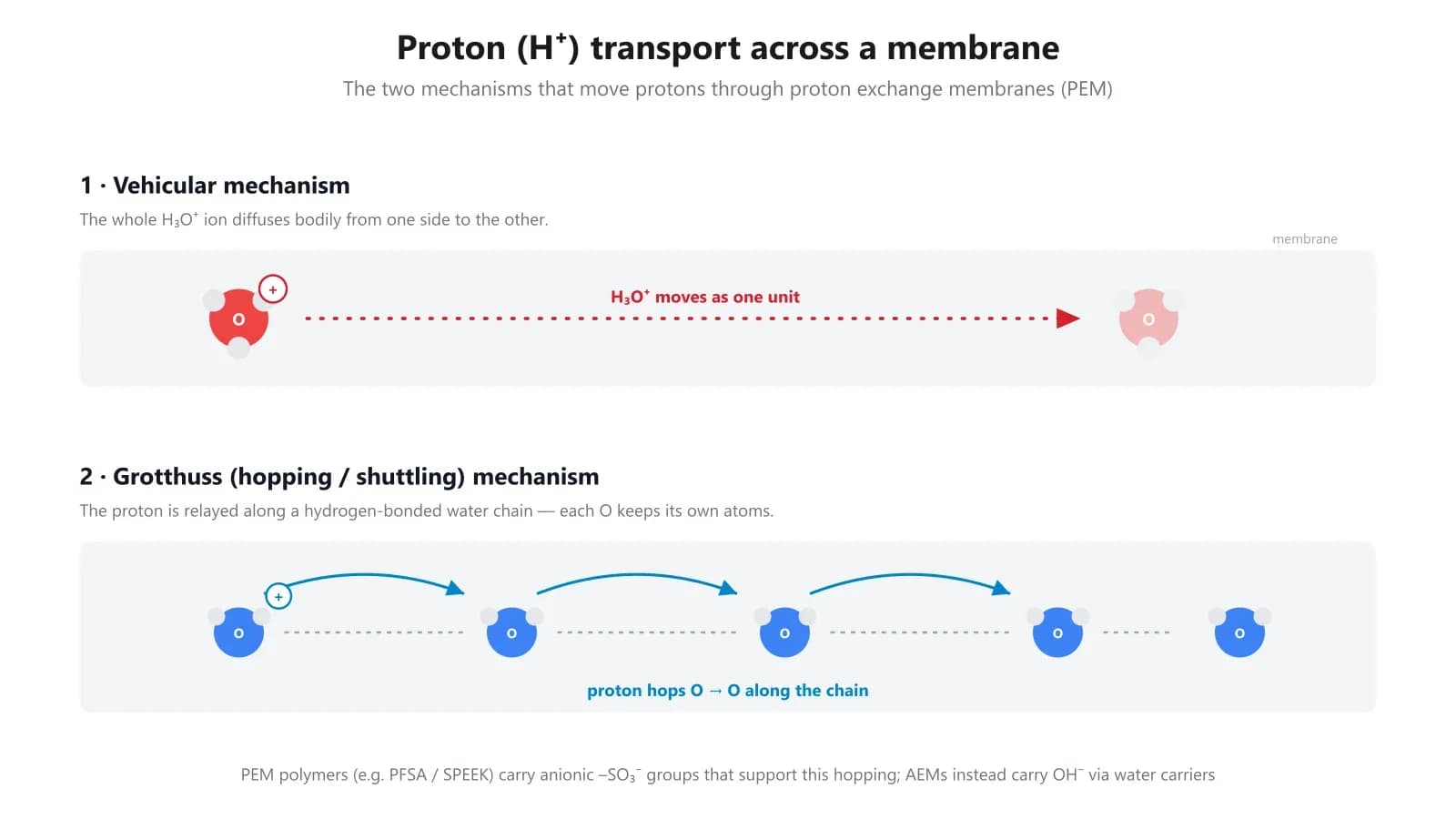
Meanwhile, AEMs are used in many applications at industrial level, especially in the food industry, where AEMs are used for deacidification of juices, dairy processing and more. AEMs grabbed the attention of researchers and scientists for green hydrogen applications between the mid-2010s and 2020. One of the reasons is the high cost of the catalysts used in PEM water electrolyzers and fuel cells. Similar to the mechanisms explained above, AEMs transport OH- ions where the carriers are water molecules with hydrogen bonds, unlike in PEMs where dative bonds are present. Polymers used in AEM synthesis include cationic functional groups, with quaternary ammonium (e.g. –[N(CH3)3]+), one of the more stable cations, being widely used.
Beyond the chemistry of ion transport, membrane selection also depends on physical and electrochemical properties such as thickness, melting point, swelling ratio, tensile strength, porosity, areal resistance and ionic selectivity. As a rule of thumb: the thinner the membrane, the higher its conductivity and the lower its strength. Likewise, the higher the porosity, the higher the electrolyte-holding capacity — decreasing resistance, but simultaneously increasing water uptake. It is also important to use dense membranes with no or very low pore size to avoid gas transport across the membrane.
About the author
METNMAT Research Team
Was this article helpful?
Have research worth publishing?
Submit an article proposal for editorial review by the METNMAT team.
Related articles
CO₂ Fuel Cells: Turning a Greenhouse Gas into Stored Power
Metal–CO₂ cells turn carbon dioxide from waste into an active reactant — reducing it at the cathode while storing energy at high density. Where the science stands, and why the remaining bottlenecks are, above all, materials problems.
METNMAT Research Team
- CO₂ Reduction
- Energy Storage
- Catalysis
- Metal–CO₂ Cells
Anion Exchange Membrane Water Electrolysis (AEMWE)
How anion exchange membrane water electrolysis works — cell components, electrolyte choices and the four cell configurations — and why AEMWE is emerging as an economical route to green hydrogen.
METNMAT Research Team
- AEMWE
- Water Electrolysis
- Green Hydrogen
- Electrolyzers