Anion Exchange Membrane Water Electrolysis (AEMWE)
How anion exchange membrane water electrolysis works — cell components, electrolyte choices and the four cell configurations — and why AEMWE is emerging as an economical route to green hydrogen.
- Authors
- METNMAT Research Team
- Published
- Updated
- Updated 25 Aug 2026
- Reading time
- 2 min read
Abstract
Anion exchange membrane water electrolysis (AEMWE) splits water into hydrogen and oxygen using an anion exchange membrane sandwiched between the anode and cathode. This article walks through the working principle and cell construction — catalysts, current collectors, gaskets and endplates — the role of the KOH electrolyte, the four electrolyte-feed configurations, and the cost advantages of AEMWE over proton exchange membrane water electrolysis.
- Keywords
- AEMWE, water electrolysis, anion exchange membrane, green hydrogen, electrolyzer, KOH electrolyte, PEMWE
- Research area
- Water electrolysis
Water electrolysis is the process of splitting water into hydrogen (H2) and oxygen (O2). This can be achieved via different processes, including electrochemical, photochemical, photoelectrochemical, thermal and mechanical routes. Electrochemical and photoelectrochemical processes have gained importance due to their comparatively high energy efficiency. It is very important to make sure that the hydrogen produced is not mixed with oxygen — which could lead to a highly exothermic reaction producing water — while also maintaining hydrogen purity. One of the main reasons industries and researchers focus on membrane-based electrolyzers is their low area utilisation, creating a high energy density.
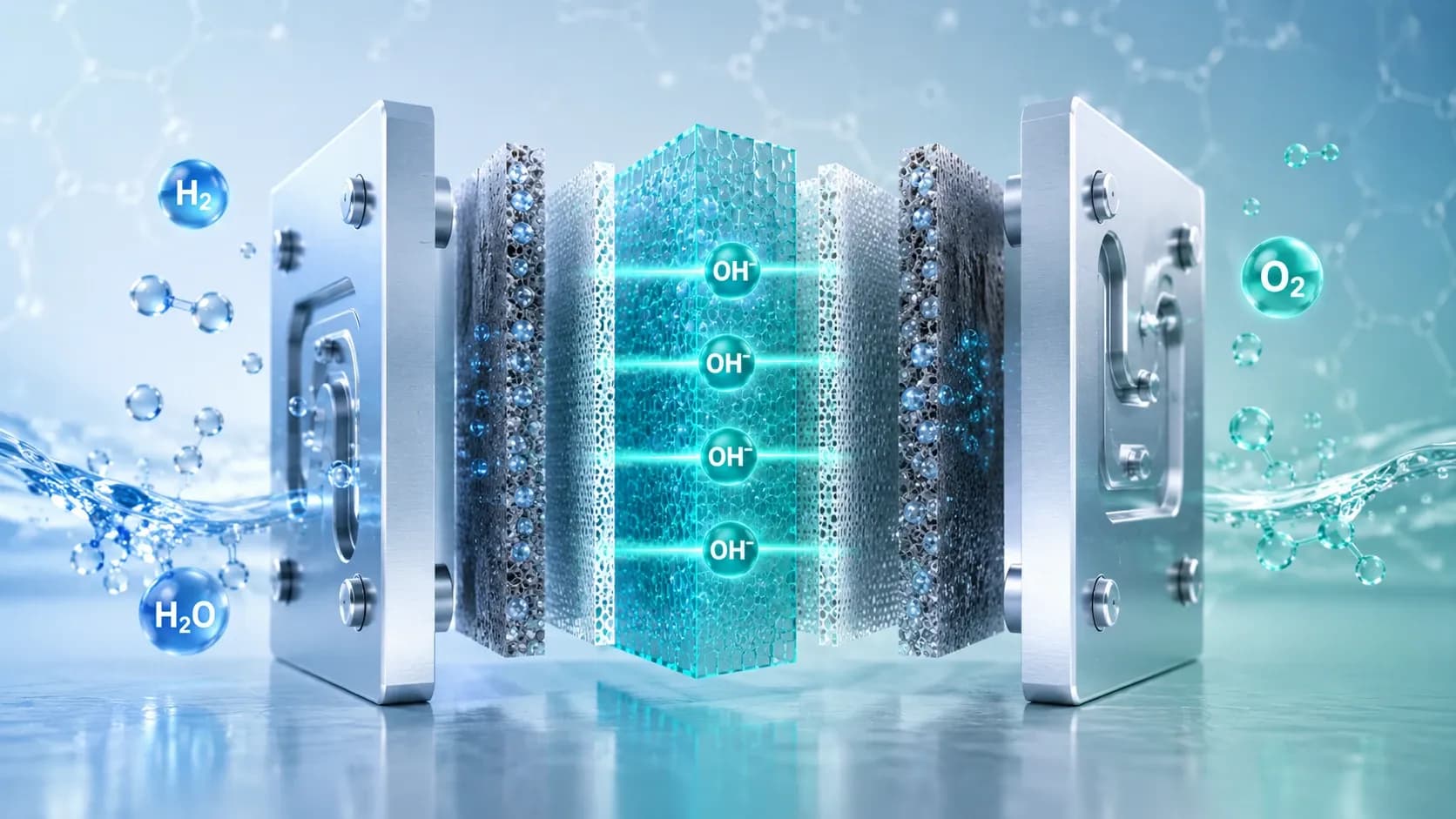
Anion exchange membrane water electrolysis (AEMWE) involves oxidation of OH- ions on the anodic side and reduction of H2O into H2 on the cathodic side. The OH- ions produced during reduction on the cathodic side are transported through the anion exchange membrane to the anodic side, completing the circuit. Hence the main components of an AEMWE cell are the cathode and anode (usually catalysts) with a membrane sandwiched in between. To supply electricity, the cathode and anode are attached to current collectors, and channels are machined into the current collectors themselves to allow the flow of electrolyte and products in and out of the cell. Direct contact between the anodic and cathodic current collectors is avoided by introducing two gaskets (non-conductors). In addition, endplates can be fitted on both sides of the cell, with gaskets between the collectors and the endplates.
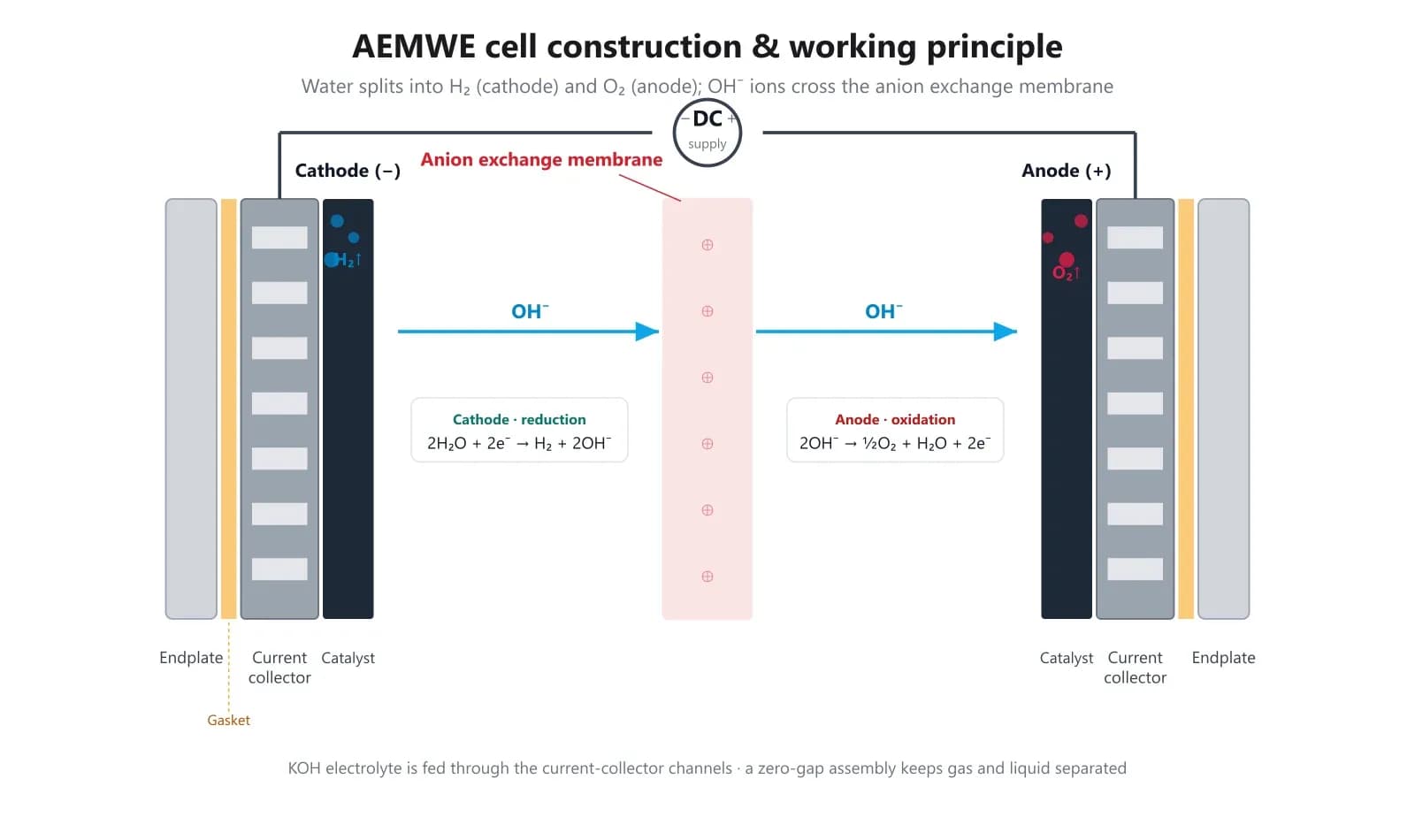
The electrolyte used for AEMWE is typically a KOH solution, which enhances the reaction kinetics compared to pure water. Apart from the catalyst and membrane efficiencies, cell efficiency also depends on the electrolyte concentration, the flow rate and the number of channels in the attached current collectors. Beyond efficiency, it is very important to ensure the cell has zero gap, so that neither the produced gas nor the liquid electrolyte can pass where it should not.
Depending on how the electrolyte is fed, there are four different kinds of cells. In the most widely used configuration, liquid electrolyte is passed through both sides — cathode and anode. In the sweeping-gas configuration, one side of the cell is fed with an inert gas while an alkaline solution is passed on the other. If one side of the cell is instead maintained under vacuum, the cell is known as a vacuum-based water electrolyzer. A further type involves sweeping inert gas on the anodic side, in which case H2O molecules — rather than OH- ions — are transported across the membrane. In comparison with proton exchange membrane water electrolysis (PEMWE), AEMWE is preferred because the catalysts used are economical, and it has been reported that the start-up time for electrolysis is lower for AEMWE than for PEMWE.
About the author
METNMAT Research Team
Was this article helpful?
Have research worth publishing?
Submit an article proposal for editorial review by the METNMAT team.
Related articles
Ion Exchange Membranes (IEM)
What ion exchange membranes are, how protons and hydroxide ions move through them, and the physical and electrochemical properties that decide which membrane fits your electrolyzer or fuel cell.
METNMAT Research Team
- Membranes
- PEM
- AEM
- Green Hydrogen